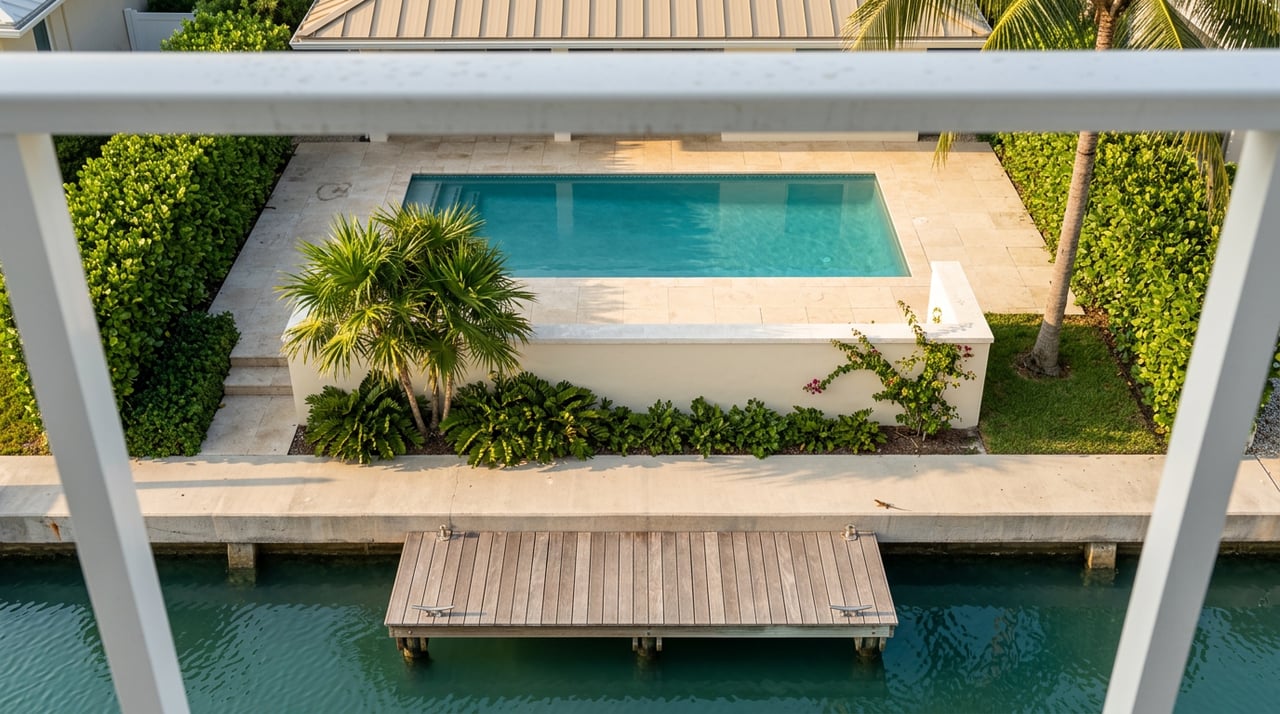
Canal depth and the route to open water can vary considerably from one Ramrod Key property to another.
On Ramrod Key, "waterfront" can describe homes with very different relationships to the water, so buyers should confirm what kind of canal access a property offers before choosing it.
Same Word, Three Different Docks
Ramrod Key sits around Mile Marker 28 in the Lower Keys, split by the Overseas Highway into an ocean side and a bay side, and the two halves don't behave the same way in the water.
On the ocean side, homes reached from Indies Drive and West Indies Drive face New Found Harbor, with a controlling depth close to four feet and a real shot at reaching open water without passing under a bridge. This is the side where listings talk about quick runs to Looe Key Reef inside the Florida Keys National Marine Sanctuary, and where boat lifts rated for real weight actually make sense.
On the bay side, the picture splits again. Some lots are dry, meaning there's no navigable water at all despite a canal-adjacent address. Others sit on working boating canals that behave like the ocean side. And some sit on canals that are effectively plugged, cut off from any through-connection, which means the water is decorative rather than functional for a boat.
A buyer scanning listings for "waterfront" on Ramrod Key is really choosing between three different products:
- Ocean-side canals with real depth and bridge-free access to the Atlantic
- Bay-side working canals with genuine but sometimes shallower boating access
- Bay-side dry lots or plugged canals where the water is a view, not a route
Canal access may not be available as a home-search filter, so compare the property details and confirm the route directly.
What "No Bridges" Is Actually Promising You
Listings on Ramrod Key lean hard on the phrase "no bridges," and for good reason. One recent listing in Breezeswept Beach Estates advertised a 60-foot composite dock built in 2022, complete with a 14,000-pound lift and a 6,000-pound lift, and pointed buyers toward easy days exploring nearby Picnic Island and its sandbars. A different listing in the same subdivision led with a brand new 58-foot composite dock as its main selling point. A third touted immediate ocean access with no bridges and an easy turnaround from its own 60-foot step-down dock. A vacant waterfront lot on the market went further still, describing direct ocean access with no fixed bridges as ideal for serious boaters with vessels up to 60 feet.
That phrase is doing real work. No bridges means no fixed clearance to plan around, no low-tide timing forced by a span overhead, and a straighter shot to blue water. For a buyer who wants to keep a serious boat and use it often, that single detail can matter more than an extra bedroom.
But "no bridges" describes the exit, not the canal itself. It says nothing about whether that canal is deep enough at low tide, whether it flushes with tidal movement or sits stagnant, or whether the approach is a straight run or a technical path that requires local knowledge. Two homes can both legitimately claim no-bridge access and still offer completely different days on the water.
The Subdivision That Proves the Point
Breezeswept Beach Estates is a useful case study because it contains its own contradiction. One listing inside the subdivision specifically marketed itself as sitting on one of only two flow-through canals in the entire neighborhood, framing that oversized corner lot as the reason the home earned a renovation with what the listing called quality construction and thoughtful upgrades.
If only two canals in a subdivision flow through, the rest are dead-end by definition. Dead-end canals aren't automatically bad, plenty of boats live happily in them, but they behave differently. Water exchange is slower. Sediment can build where there's less current to clear it. Depth at the mouth can be shallower than depth further in, and boaters should confirm conditions along the route before relying on it.
A flow-through canal and a dead-end canal in the same subdivision, at similar price points, are not interchangeable products. They're two different ownership experiences wearing the same subdivision name.
Why This Matters More in Today's Market
This kind of due diligence has always mattered for boaters. It matters more right now because the Florida Keys market has stopped giving buyers time to figure it out slowly.
The median sale price for Florida Keys residential properties reached $965,000 in May 2026, up 12 percent from a year earlier, a gain that matched January for the strongest year-over-year increase of 2026 so far. Active inventory that same month was down slightly from a year prior, essentially flat, which means that price growth showed up because demand outpaced a supply that barely moved. Key West itself saw its median sale price climb to $1.3 million over the three months ending June 2026, a 28 percent jump from the same period the year before. Luxury waterfront listings across the Keys were down roughly 22 percent in new inventory during the first quarter of 2026 compared to the prior year, tightening the field further for exactly the kind of boater-focused buyer drawn to a place like Ramrod Key.
Put plainly, sellers are fielding faster interest on well-priced waterfront homes than they were a year ago, and buyers have less room to negotiate for a slow, careful look before offering. That's precisely the environment where skipping the canal question costs you. If you're moving quickly because a home is priced right and getting attention, the depth at low tide and the flow-through status of the canal need to be settled before you write the offer, not during a home inspection contingency you may not have room to include.
Questions to Ask Before You Write an Offer
A listing photo of a dock tells you almost nothing about whether your boat belongs there. Before getting attached to a specific address on Ramrod Key, it's worth asking directly:
- What is the controlling depth at mean low water, not just at the seawall but along the full length of the canal to open water
- Is this canal flow-through or dead-end, and if dead-end, how far is it from the mouth
- How many bridges, if any, stand between this dock and open water
- Which subdivision and street is this on, and how does that canal compare to others nearby with the same address prefix
- Has the seller or a neighbor navigated this stretch with a boat similar in draft to what you plan to keep here
On Ramrod Key, the dock in the photo is real. What that dock connects to is the part worth confirming before you sign anything.
A Few More Questions Worth Asking
Does "waterfront" always mean deep water on Ramrod Key?
No. The bay side of the island includes dry lots and canals with no through-access, alongside canals that function just as well as anything on the ocean side. The word waterfront covers all of it.
Can a bay-side home still be a good choice for a boater?
Often, yes. Working canals on the bay side can offer solid access, and pricing there sometimes reflects less name recognition than the ocean-side streets. The key is confirming the canal isn't plugged and that depth supports the boat you actually plan to keep.
Is there a way to check canal depth before touring a home in person?
Local knowledge and direct conversation with someone familiar with that specific canal is more reliable than anything printed in a listing. Depth can vary block to block even within one subdivision.
If you're weighing a canal-front home on Ramrod Key against something on a neighboring island, the details above are exactly the kind of thing worth working through before you fall for a dock in a photo. Joyce Craul has spent years walking Lower Keys buyers through these distinctions one canal at a time, and she's glad to talk through what a specific address actually offers before you make an offer on it.
This article is general information, not legal, tax or financial advice. Consult a qualified professional about your situation.