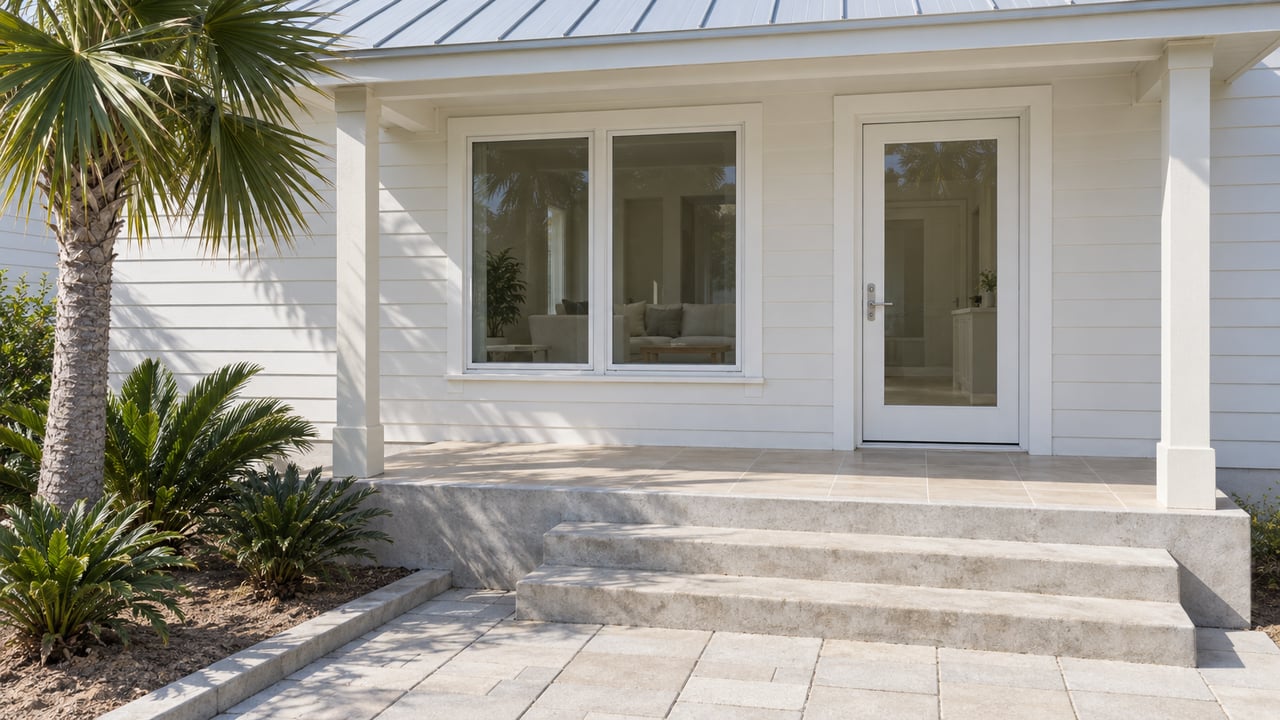
Most Lower Keys buyers who want to replace or build a home end up dealing with ROGO, Monroe County's permit allocation system. Inside the gates of Venture Out on Cudjoe Key, most of that problem goes away. The county's comprehensive plan exempts the redevelopment or replacement of any lawfully established Venture Out unit from ROGO, as long as the community doesn't grow beyond the number of units that existed on or before January 4, 1996.
The exemption comes with two conditions. The county requires every Venture Out occupant to leave earlier than other permanent residents when a major hurricane threatens. The association caps what you can put on the ground at a size most mainland buyers would call a cottage. That bargain decides what a Venture Out purchase is worth to you, more than the asking price does.
A Condo Made of Ground
Venture Out at Cudjoe Cay, Inc. describes itself as a residential condominium association with 659 privately owned units. If you're coming from the Northeast, "condo" probably means an apartment in a shared building. Here, each unit is a parcel inside a gated community at roughly mile marker 21 to 23, and the owner decides what stands on it within the rules. In the association's April 1, 2026 FAQ, ownership for voting purposes is defined as ownership in fee title, with one vote per unit. Someone who owns two units gets two votes.
The county regulates the units because each one counts toward the Keys' hurricane evacuation math. The association regulates the structures because owners share the community's roads, setbacks, and look.
The Exemption, in the County's Own Words
The Venture Out provision sits in Monroe County's comprehensive plan, under the policy that sets up the ROGO system. It appears in a county planning document prepared for a November 24, 2025 community meeting on a separate workforce-housing amendment. The key sentence reads:
"the units within Venture Out may be developed as either detached dwelling, mobile home or recreational vehicle use through the approval of a building permit"
That interchangeability is unusual for the Keys. In the same text, the county limits it to "the gated Venture Out community with a managing entity responsible for evacuation." It also says no unit of any type may be transferred to a site outside Venture Out. The right to rebuild stays with the parcel and can't be moved somewhere else.
RV use carries its own conditions under the county text:
- RV occupancies or tenancies of six months or more are prohibited
- RVs must keep current highway-travel licenses and connect only through quick-disconnect utilities
- No permanent additions such as sunrooms or state rooms are allowed
- RVs can't be developed as a hotel or motel
What the Exemption Costs: An Earlier Exit
Monroe County runs a phased evacuation when a Category 3 to 5 hurricane is approaching. The timing depends on who you are and what you live in, and Venture Out has its own line in that schedule.
| Hours before tropical storm winds | Who is ordered to leave |
|---|---|
| About 48 | Visitors and non-residents, RVs, travel trailers, live-aboard vessels, and early-evacuation workforce units |
| At least 48 | All Venture Out occupants, whatever the unit type |
| About 36 | Mobile home residents, special needs residents, hospital and nursing home patients |
| About 30 | Permanent residents, phased by zone; Cudjoe Key sits in Zone 2, Boca Chica Bridge to the west end of the Seven Mile Bridge |
So a permanent home inside Venture Out leaves on the same clock as an RV. In its own words, the county requires this "to not increase the hurricane evacuation clearance time of permanent residents." Skipping the ROGO queue is paid for in evacuation hours. If you plan to live here full time, that's the clause to read twice. If you'll mainly use the place in winter, it may barely affect you.
The Second Rulebook Sets the Ceiling
Under the county's rules, a unit may be a house, a mobile home, or an RV. The association's Rules and Regulations then decide how big and what kind. The most recent version publicly available lists board-approved revisions dated January 10 and April 8, 2024. Later changes would live in the owner portal.
That version permits three kinds of permanently installed residential units:
- Manufactured, also called mobile, homes built after July 17, 1994 that meet HUD codes or ANSI park model specifications
- Park models built after July 17, 1994 that meet ANSI specifications
- Modular homes that comply with state and local codes
The same section sets these size and finish limits.
- Living space: no more than 865 square feet, and areas enclosed by shades, glass, or shutters count toward it
- Height: no more than 13 feet, not counting piers, columns, or tie beam
- Elevation: the underside of the support beams must sit at 9 feet or Monroe County's minimum, whichever is greater
- Setbacks: at least 1 foot on the primary sanitary sewer side, 10 feet from the water's edge, and 5 feet from all other property lines
- Finishes: siding of vinyl, aluminum, cement board, or stucco in white or a pastel color
The enclosure rule is easy to miss. Closing in a porch with glass or storm shutters counts toward the 865 square feet, so a screened-room project that looks minor on paper can use up a large share of your remaining space. The association also requires its own permit for any visible or structural work over $200 in materials. The application costs a $15 nonrefundable fee plus a $100 refundable deposit, and changes to the footprint need a certified survey and scaled plans with elevations.
Where the Two Rulebooks Don't Line Up
The county text allows a "detached dwelling." The association's list of permitted residential units names manufactured homes, park models, and modular homes, and it doesn't name a conventional site-built home. The public documents don't say whether a site-built stilt home would be approved, refused, or handled as a variance, which needs written association approval for noncompliant construction.
Think of Venture Out as two layers. The county sets the outer limits on what a unit may be. The association, working inside those limits, decides what actually gets built. If you're looking at a lot and picturing a custom build, the association's current rules are the document that answers that question.
The Quarterly Bill, and Where Half of It Goes
According to the association's April 1, 2026 FAQ, each owner pays 1/659 of the cost of operating and maintaining the common elements, billed quarterly. For the current fiscal year, the FAQ lists $739.31 for reserves and $820.92 for maintenance and gives the quarterly total as $1,560.24 per unit, one cent more than those two lines add up to. Using the stated total, that's about $6,241 a year, and about 47 cents of every dollar goes to reserves. Installments are due in April, July, October, and January. As of the 2024 rules, an account more than 30 days late is charged an 18 percent annual finance charge plus a $25 quarterly late fee.
That quarterly figure covers a lot. The same FAQ says owners don't have to join any other association and don't pay separate rent or land-use fees for recreational facilities. The association's website lists a private marina, an oceanfront pool with spa and kiddie pool, two double-wide boat ramps for residents, a swim lagoon, a community store, courts, a recreation hall, and laundry.
Renting It Out Runs Through the Gate
The FAQ says the declaration places no restriction on renting beyond the rules the association adopts. The association says it doesn't book, lease, or manage individual properties, so owners handle rentals themselves or hire independent managers. Renters register with the community and pay a $125 registration fee at check-in.
The 2024 rules add more detail. Leases under six months count as short-term and leases of six months or more as long-term, and the short-term section doesn't set a nightly minimum. No more than six renters may occupy a unit at once. Owners or their managers register the rental dates, every occupant, and any pets, vehicles, trailers, and watercraft. Long-term tenants complete an application, and adults go through a background check before a gate pass is issued. Under the association's rules, an RV on an RV lot may be occupied only by its registered owner and title holder, including their immediate family. That's tighter than the county's own RV limits.
Quick Answers
Does the ROGO exemption mean I can add a second unit to my lot?
No. Under the county text, the exemption covers replacing or redeveloping an existing lawful unit only if the total doesn't go above the number that existed on or before January 4, 1996.
Could I swap a mobile home for an RV, or the other way around?
The county text allows those uses to be interchanged inside Venture Out through a building permit. The association also has to issue its own permit, and its construction and RV rules apply.
Where else can I launch a boat nearby?
Monroe County reopened the public boat ramp at the end of Blimp Road, bayside at MM 21.2, after it had served as a staging area for airport taxiway mitigation work, as Keys Weekly reported in July 2026.
Is the 865-square-foot cap still current?
It's the limit in the most recent publicly available Rules and Regulations, last revised in April 2024. Ask for the current rules during your contract review.
If Venture Out is on your list, I can help you put the county exemption, the association's rules, and the quarterly assessment next to the specific unit you're considering, so you know what the parcel lets you build before you commit. Reach out to Joyce Craul. Let's Connect.
This article is general information, not legal, tax or financial advice. Consult a qualified professional about your situation.