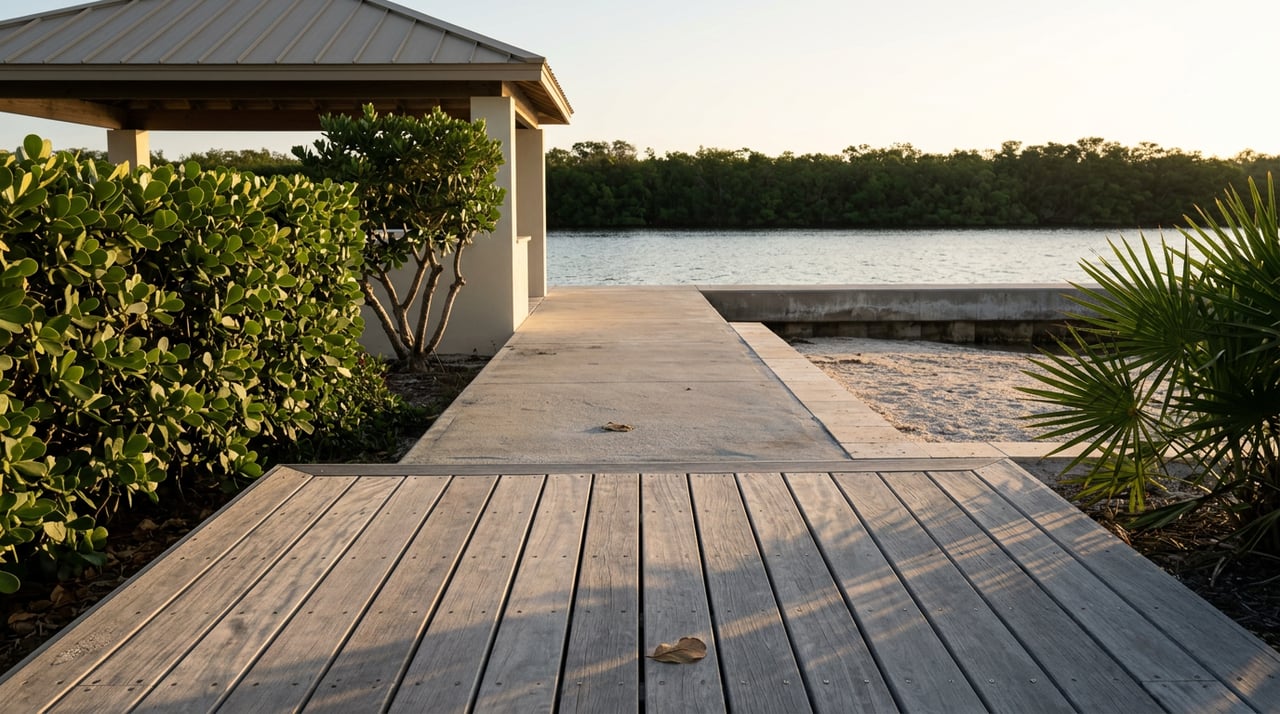
Ask anyone who has just moved to the island where to swim, and the answer arrives fast: head up Highway 1 toward the Seven Mile Bridge, look for the brown sign, park at Veterans Memorial Park. It is the beach every travel site lists under Little Torch Key. It is also, according to Monroe County's own facility records, not on Little Torch Key at all.
The county lists the park's address as 39900 Overseas Highway, Little Duck Key, FL 33043. The zip code alone gives it away. Little Torch Key runs on 33042, the same code stamped on Kiki's Sandbar and on The Dining Room at Little Palm Island. Veterans Memorial Park sits at Mile Marker 40, eleven and a half mile markers north of Kiki's at MM 28.5, on the far side of Big Pine Key, closer to Bahia Honda than to anything Little Torch residents would call home. Travel directories keep filing it under Little Torch Key anyway, probably because it is the closest sandy stretch to the string of islands that actually lack one.
That gap matters more than a mapping quirk. It means Little Torch Key, in the strict sense of the island itself, has no public swimming beach. What it has instead is a handful of private and semi-private water access points that carry the weight a public beach would normally handle, and understanding which is which tells you more about how the island actually runs than any brochure will.
What the county park is actually for
None of this is a knock on Veterans Memorial Park. It is a genuinely useful stop, just not for the reason its listing implies. The shallow water is better suited to wading than swimming, threaded with sandy paths that let kids walk out a long way before the bottom drops. A small plaque near the parking lot marks a Cuban refugee boat that washed ashore there, a quiet piece of history that most people who stop for a picnic never read past the first line. A boat ramp on the gulf side gets more consistent use than the beach itself. And for years, a vendor named Tony, a Big Pine Key native, has sold coconuts from the same spot near the far end of the parking lot, the kind of fixture that outlasts whatever else changes along the road.
It is a fine place to stretch your legs on a drive to Marathon. It is not where Little Torch Key itself gathers.
The dock that never advertised itself as a beach
If there is a single place on the actual island that functions as its front door, it is Dolphin Marina, and it earned that role by accident. According to Keys Weekly, the property was once the homestead of Bern and Betty Brothers, who settled there in the 1950s with a lagoon, a marina, a home, and three rental cottages. As the story goes, a wild dolphin swam into the lagoon one day and kept coming back until the Brothers considered her theirs. They named her Dal. Years later they gated the lagoon and brought in a companion, a male dolphin named Suwa, sourced through a Grassy Key connection. Dal and Suwa lived in that lagoon together for twenty years. Betty eventually wrote a book about it, and the marina kept her name in the process.
Today the same property serves as the welcome center and ferry launch for Little Palm Island, the thatched-roof resort reachable only by boat or seaplane. No bridge connects it to the mainland, which is the entire point of staying there. The Dining Room at Little Palm Island runs its beachfront tables and candlelit dinners for guests who arrive by water, and the marina dock is where that whole experience begins for anyone approaching from Little Torch Key rather than by seaplane. It is not a swimming spot. It is closer to a departure gate, and locals treat it that way, whether they are dropping off overnight guests or just watching the ferry pull out at sunset.
Where the island actually spends a Thursday night
For anything resembling a public gathering spot, the island leans on Kiki's Sandbar, tucked at Mile Marker 28.5 on the gulf side. It is a restaurant first, with grouper sandwiches and Ahi tuna nachos drawing the daytime crowd, but its calendar is what turns it into something closer to a community room. Live music runs several nights a week on the beach side, drawing a mix of regulars and boaters who tie up at the complimentary dockage rather than driving in. The restaurant has run a lighted boat parade in past Decembers, timed for regulars who would rather show up by water than by car, and it has also hosted a Dolphin Tournament, the kind of fishing competition where cash prizes matter less than the excuse to gather afterward.
None of this happens on a public beach. It happens on a private dock and a restaurant patio, which is a small but real distinction if you are trying to understand how an island with almost no businesses still manages to have a social life.
The other private beach, and where the water starts
A few minutes down the road, Parmer's Resort keeps its own ninety-foot private beach, heated pool included, open mainly to guests but still part of the island's water-access patchwork. What matters more for residents is what launches from there: Dave's Kayaks operates out of the resort, offering backcountry routes that Dave himself will point you toward rather than a generic map, and Salty Fun by Solé runs private boat tours out of the same marina. Between the two, Parmer's functions less as a hotel and more as a staging ground for people who want to get onto the water rather than just look at it from a beach towel.
That backcountry access matters because it points toward the real reason nobody on Little Torch Key seems bothered by the missing public beach. Looe Key National Marine Sanctuary sits about six miles out, one of the most consistently cited snorkeling and diving sites in the Keys. If your idea of a swim involves visibility past your own hands and a reef instead of turtle grass, you are getting in a boat regardless of whether there is a strip of sand nearby. The island's whole relationship with water skews toward launch points rather than shorelines, which is exactly what Dolphin Marina, Parmer's, and the handful of kayak and charter operators provide.
An island named for what grows on it
The island's name comes from the torchwood tree, a small citrus-family plant that tops out around fifteen feet and blooms with fragrant white flowers before producing a dark, cherry-like fruit. It grows here, on Middle Torch and Big Torch, and across parts of the Caribbean, and it is the reason all three islands share the Torch name rather than something tied to a wreck or a person, which is how most of the surrounding Keys got theirs. It is a small detail, but it explains something locals already sense: this stretch of the Lower Keys was named for what grew here naturally, long before anyone built a marina, a resort dock, or a tiki bar to gather around.
That is really the throughline. Little Torch Key never developed a commercial strip, a downtown, or even a public beach of its own, and it never seems to have needed one. What passes for a gathering place here is a working marina with a dolphin's name still attached to it, a restaurant that times its calendar around live music and a boat parade, a resort beach that exists mainly to launch kayaks from, and a reef six miles out that makes a sandy shoreline feel almost beside the point. If you want the postcard version of a Keys beach day, you drive eleven miles north to a park that technically belongs to the neighboring island. If you want to understand how Little Torch Key actually spends its evenings, you look at the water, not the sand.
If you are settling into the rhythm of this stretch of the Lower Keys, or thinking about what it would take to make a home here permanent, Joyce Craul has spent nearly two decades learning these islands from the inside. Let's Connect.